Tuesday, 29 May 2012

The Bones of Avignon. - Jefferson Bass

Synopsis: 

It’s the discovery that will make Miranda Lovelady’s career… if she can prove it. And the secret she’s unearthed is enough to convince Doctor Bill Brockton to abandon the Body Farm and fly to Avignon. The medieval city is picturesque, but deadly. When their colleague is found crucified in a ruined chapel, Brockton and Miranda become entangled in a terrifying conspiracy, far bigger than either of them can imagine. For the bones of Jesus of Nazareth would be the find of the millennium.

Review

The Bones of Avignon is the seventh novel in the Body Farm series, and is the most ambitious one to date. The writing partnership that gives its name to ‘Jefferson Bass’, Jon Jefferson – veteran journalist and documentary filmmaker – and Dr Bill Bass, a world-famous forensic archaeologist, is a fantastic collaboration, producing a wonderful blend of culture and history, juxtaposed with fiction. The result, it has to be said, is a truly thrilling tale through time.

Dr Bill Brockton, whisked from the routine of the Body Farm, arrives at the ancient city of Avignon, with no clue of what is going on. Not long after, he is wishing he had remained ignorant. Stephen, Miranda’s colleague and old flame, has a discovery which will change everything: bones that will threaten to destroy a secret that has remained hidden for two thousand years.

The reader, through terrific description and a ferociously paced plot, is taken on a sprawling journey; from the hidden dungeons of the Palais de Papes, to the Cathedral of Saint John the Baptist, which holds the infamous Shroud of Turin. We move on a journey with the characters as they strive to answer questions that for a long time have gone unasked. As they attempt to unravel the mysteries, there are those that are determined to stop them; many eyes watch in the shadows of the night, each with their own agenda.

From a kind-hearted priest that takes pity on the doctor when he receives some bad news, to the delightful couple that house Bill Brockton in the charming Lumani residence, the authors weave a rich web of characters through our tale. Painters from the past, their actions shown to us in flashbacks, a dangerous fanatic that plans to bring the world to its knees. Who can be trusted in a tale where one misplaced instinct could bring disastrous circumstances?

The Bones of Avignon is a story of murder and blood, death and deception. A combination of history and fiction gives the reader a tale rich with action, each page promising to bring new twists and turns in the journey to discover the true meaning behind the bones of Avignon.

4/5.

Changes

Wrote this one in September 2011 and it really speaks for itself.

Changes

People may change with the winds of time,
Yet I still think of us, your lips upon mine.
One moment so golden, yet frozen forever,
Raindrops they fell, as we stood there together.

In a blink of an eye, the moment was gone,
From that point on, it all began to go wrong.
A sense of distress, I thought I should go,
Suspicions confirmed; it hurt more than you know.

Yet despite the pain, it never ruined the night,
It's never hard to remember, that memorable sight.
So nervous, I held my breath; I had waited too long,
It was our defining moment; the chorus of our song.

Through it all we battled, problems we overcame,
The greatest gust couldn't douse our friendship flame.
Years that with you, have been the best of my life,
At the end of the day, happiness outweighs the strife.

I sit here and think of us, and wonder what's left,
My life begins to lack colour; it's lonely and bereft.
Promise me please, as I pray this isn't the end,
I miss you terribly even now, on you I do depend.

So as life begins to rush upon us, think of our good times,
Relax and sit back, as the final bell chimes.
As the curtain falls, the players bow; the final sun shall set,
I know not the future changes, but you I won't forget.

© Ben Johnson 2011

Friendship Comes In Many Forms

Here is a poem I wrote in August 2011 after I realised a certain someone would always be there for me.

Friendship Comes In Many Forms

Today was just a stark reminder:
Friendship comes in many forms,
Despite the anger, despite the hurt,
With you I can weather these storms

Relief that passes through my mind,
When I know that you'll be there,
Metaphorical shoulders to rest my head,
As my hands tear through my hair

A heart that bleeds, I long to scream
Such frustration I can't contain,
Yet every time I feel like giving up,
Your words guide me through the pain

I've stood resolute with nothing left,
Almost breathed my very last,
Then in my ear, those voices whispered,
Reassured, the moment passed

Saved from upon the very brink,
So melodramatic but it's true,
Battled on despite the hurt,
I owe so much to you

These words I write can't say it all,
But know your kindness transforms
Those broken hearts, those ruined souls:
Because friendship comes in many forms

© Ben Johnson 2011

Friday, 10 February 2012

A Midsummer Night's Dream

Shakespeare's comedic play, A Midsummer Night's Dream, was in fact my earliest introduction to the world of the great Bard, William Shakespeare, although at the time, when I was around nine or ten, I imagine that his greatness was far from understood by me, or indeed any of my class-mates, when we were told we would be performing in a school production of it. This mysterious 'Shakespeare' was far from known to us, and I was worlds away from understanding his reputation and genius.

In essence then, the girls were excited about getting dressed up, and the boys were mainly content with the competitiveness of securing the 'best' parts. Well, I say this - but it's quite possible that in some early display of geekery on my part, it was simply I who became anxious over who should get what part. Some childish whim that to have a great part would be to get one over on my friends. In the end, I got the part I wanted - that of Puck, or Robin Goodfellow - and with my best friend procuring the part or Oberon, we were ready, and the stage was set.

Eight or so years later, re-reading the play, I can't imagine that the language we used was the original, but nevertheless I do believe it's great that schools attempt to offer at least some sort of Shakespearian education to kids growing up. It's important, and I feel that everyone should have some knowledge of his works. The play itself is an enjoyable one, as we follow the events surrounding the marriage between the Duke of Athens, Theseus, and the Queen of the Amazons, Hippolyta; the adventures of four young lovers, and the antics of an amateur group of actors.

The fairies that inhabit the forest in which most of the play is set, meddle and manipulate all those around them, causing havoc. Shakespeare weaves a wonderful plot of love and betrayal, magic and marriage, set mainly in the depths of the night - where Oberon and his obedient, mischievous servant Puck, rule and roam at will. The lovers are merely puppets upon a string, subject to the mere whims of the magical creatures about them, as they argue, love, and trade blows, unaware of what's really going on.

In the end, then, what happens is never really their choice - the fairies will decide if the mischief shall continue, or if normality should be restored.

Saturday, 4 February 2012

Edgar Allan Poe: Detective Tales

After studying 'The Black Cat' and 'The Tell-Tale Heart' by Poe last year, I was looking forward to reading some more of his short stories, and I wasn't disappointed. These two tales that I had to read for my Crime Fiction module, were written in 1841 and 1844 respectively; 'The Murders in the Rue Morgue' appearing in the nineteenth century periodical Graham's Magazine - and 'The Purloined Letter' being produced in the literary annual The Gift for 1845 four years later.

'The Murders in the Rue Morgue'

The first tale, 'The Murders in the Rue Morgue' is the the first appearance of the reclusive intellectual C. Auguste Dupin, and his side-kick; the unnamed man who narrates the tale. Much in the same vein as Holmes and Watson, these two spend time in each others' company, mediating on the issues of the day, content with living somewhat aside from the rest of society and enjoying their own company.

After hearing about the murders in the Rue morgue, Dupin becomes intensely interested in the case which according to the papers, appears to be unsolvable and offers no clues. Not convinced, Dupin and his side-kick set about investigating the scene of the murder themselves. For the narrator, things are entirely unclear, but as the mystery unfolds and Dupin's marvellous mind works to form its own conclusions, it becomes apparent that he has unravelled the mystery.

With a clever, unexpected ending, I found 'The Murders in the Rue Morgue' to be a fascinating and enjoyable read.


3/5.

'The Purloined Letter'

The third of Edgar Allan Poe's detective stories - the second being 'The Mystery of Marie Roget' - sets about its narrative in a completely different manner: from the outset the thief is known to us, and it is not the 'whodunnit' of traditional UK crime fiction, but instead the importance is placed on how Dupin sets about his work.

A letter has been stolen from an important aristocrat, and despite the police's best efforts to turn-over every last inch of the thief's rooms, they can not find what they seek. Somewhat reluctantly, they call in the help of Dupin, and the tale from then on is a story of narrow-mindedness and how the police have struggled because they can not see anything aside from ordinary procedure.

Dupin's thinking is different to that of the police, and as a result he is able to out-think the thief. In this tale, then, we see the idea of the detective having an 'intellectual counterpart' as such; an adversary that in some ways is Dupin's 'match.' Once again this indeed can draw parallels to the Sherlock Holmes mysteries, with the famous adversary Professor Moriarty.

Poe's detective stories then, are often attributed with being the forerunners for today's modern 'detective novel', and we can see why; it is clear that his ideas of the detective and of the investigative techniques he uses, influenced others, and are still present in crime fiction to this day.

Monday, 30 January 2012

Daffodils. - William Wordsworth

Today I started my Romanticism course which concentrates mainly around poetry in that period, and I have to say I enjoyed it immensely. In the seminar we focused on the first verse of William Wordsworth's poem well-known poem, Daffodils; otherwise known as I Wandered Lonely As A Cloud which was fascinating, and which I feel I grasped rather well.

I wandered lonely as a cloud
That floats on high o'er vales and hills,
When all at once I saw a crowd,
A host of golden daffodils;
Beside the lake, beneath the trees,
Fluttering and dancing in the breeze.

One of the nation's favourite and most-recognised poems, Daffodils is a poem which typifies the poetry of the Romantic movement. From the very first nuance, 'I' suggests that Wordsworth is following closely the themes of individualism and the self that were clear in poetry of this era, when writing this poem. The first line appears to me a declaration of the isolation and independence. He wanders, 'lonely', like a 'cloud' - an insubstantial, ethereal image - that 'floats on high', creating an image that has multiple layers.

As well as the theme of individualism here, we can also note how Wordsworth is playing on the idea of transcendence; of being above others. One of the main ideals of the Romantic movement, was the idea of creative artistic thought taking the place of a God, and here it seems evident that Wordsworth in writing this poem, has transcended imagination above all. Wordsworth's use of the word 'floats' seems to evoke the mythical, prophetic poetry of his contemporary William Blake.

The next line, 'When all at once', parallels his idea that poetry is 'a powerful overflow of spontaneous emotion'; Wordsworth the proponent of spontaneity, over the 'reason' championed by the eighteenth-century poets before him. The idea of a 'crowd' once more opens up the theme of individualism; this time the narrative has switched from inward self-reflection, to the idea of another perspective looking back at him.

'A host' is a phrase used that we can read a lot into, as Wordsworth once more opens up the idea of a sense of the self displaying itself to others: it seems the author here considers himself hosting a spectacle to those who read his poems. There is, however, an inclination that the daffodils represent an opening to the author himself as if they are the hosts; an invitation to Wordsworth to explore the natural beauty of the world. Once again the 'golden' image that is thrown up indicates wealth and a richness; vivid imagery for sure.

The final couplet of Wordsworth's first verse, allows him to explore nature; a theme that was ever-present in poetry from the Romantic era. The speed of the poem switches here, speeding up and perhaps indicating the flow of ideas and the change of thought that Wordsworth is trying to bring about, in contrast to the ideas of Enlightenment in the eighteenth-century. The 'fluttering' and the 'dancing' in the 'breeze' act as a further lightness in the images, paralleling with those of 'wandered' and 'floats' used earlier in the poem.


Evidently, then, Wordsworth's poem acts as a celebration of the beauty of nature, and a reconciliation between a man and the environment. The poem is emotionally song, light-hearted, and the use of personification leaves us with clear, vivid images in the readers' minds. All in all it's no wonder that the poetry of Wordsworth is pivotal in the Romantic movement, and that so many people still recognise and love 'Daffodils' even to this day.

Sunday, 29 January 2012

Australian Open Final: Novak Djokovic v Rafael Nadal

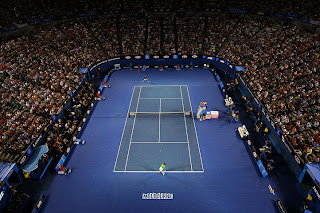
The final battle of the Australian Open came once again down to the best two players in the world; Rafael Nadal aiming to stop the world number one, Novak Djokovic, in his run of twenty wins in Grand Slam events. With both players taking part in long physical semi-finals, Djokovic coming through in five sets against Murray just forty hours ago, both players knew it would take a battle of immense endurance and physical strength to come through victorious at the Rod Laver Arena.

In a gruelling first set of an hour and twenty minutes, both players played tremendous tennis; ruthless and ferocious in their efforts to take the first advantage, knowing the importance of an early lead. Both players held their serves, battling through twenty and thirty-shot rallies with a wonderful display of skill. Then, at 5 games apiece, a breakthrough: Nadal battling to break at last, Djokovic’s serve. Holding his own in the final game of the set, Nadal served it out, and in an incredible eighty-two minutes of sensational tennis, he had the all-important first set and a 1-0 lead.

Ever the Champion though, as the second set rolled around Novak Djokovic showed why he is best player in the world. At 1-1, Djokovic began to take control as his tennis really started to click into gear. Three games on the bounce from Djokovic, and suddenly, without warning, the momentum has switched: the world number looks at ease on the court. Tennis can change in an instance, though, and just when you think Djokovic is about to level the match, serving for the set he fails to convert his two set points, and Nadal breaks him right back. It seems there’s life still in the set yet for the Spaniard, at 5-4, but to the dismay of his coaching team watching from the stands, he can’t hold his serve, and the Serbian wins the set 6-4 to level the match at 1-1.
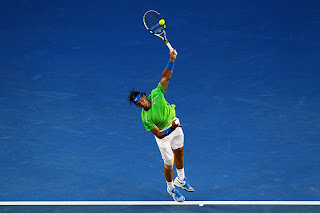

With the crowd loving every minute, the third set blistered into life with a lightning display of tennis, but this time from just one of the two men slugging it out on court: Novak Djokovic. In a tremendous display of exhibition tennis, the Serbian hit winner after winner across court, beginning to establish his dominance. Nadal looking dejected, the wind taken out of his sails, Djokovic rattled off a wonderful set 6-2, to give himself a 2-1 set lead, and leave himself one set away from his third Australian Open title. Could the Spaniard fight his way back into the game?
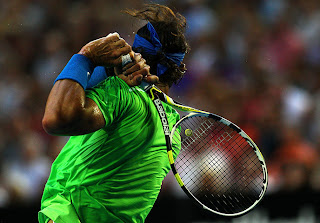
In the fourth set the crowd seemed to get behind the world number two, Nadal, wishing wholeheartedly for the match to go the distance into a deciding set. The Serbian on the other hand, seemed to have other ideas, holding his serve with ease for the early part of the set, while forcing Nadal to battle to hold his own. Nadal, always a fantastic competitor, attempted to whip up the action into a Spanish frenzy, fist-pumping and leaping into the air, trying to establish himself in the game, and break Djokovic’s serve. 4-3 in the lead, and at the most crucial part of the set, Djokovic turned on the style with a fantastic three points to lead 40-00.

Intense, and staring down the barrel, Nadal incredibly won the next two points to leave Novak with just one break point. Sensationally, he couldn’t take it, and Nadal had fought his way back to 40-40. Two points later, as the heavens began to open, Nadal had against all odds levelled the match, with an incredible fight back. With the fourth set tied at 4-4, and the game-time coming around to four hours, another twist in the tale, the rain had become too much: the game must be stopped. An agonising fifteen minutes wait for both players as the roof comes across; the game still hanging right in the balance.

With rapturous applause the two warriors returned, with Djokovic looking to wrap this up, and Nadal looking to take it the very distance – the crowd with him all the way. The combatants traded blow for blow, sublime tennis producing cheers from the crowd that shook the foundations of the Rod Laver Arena. It seemed inevitable: a fourth set tie-breaker would be required to decide in what direction this match would go.
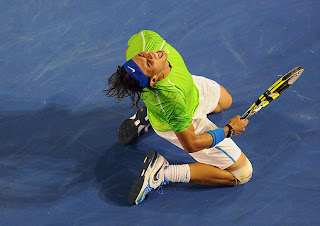

Once more the two locked swords: smashing impossible shots and hitting returns to produce lengthy rallies that in an ordinary match would have been over many shots earlier. The advantage had been on Djokovic to wrap this game up in the fourth but it wasn’t to be; Nadal battled furiously to win the tie-break 7-5, and the crowd had been rewarded: a fifth and final set would be needed to separate the two warriors.

With the games locked at 2-2 in the fifth, history had been made. These two had officially racked up the longest grand slam final in history, just moving past the five hour mark. Sensationally, both players lifted themselves for one final effort; as they matched each other serve for serve. In the sixth game, a switch of momentum in the air as Djokovic begins to tire; a break point for Nadal and he takes it to lead 4-2. Just two short games away from victory, but as always tennis can change in just a blink of an eye.
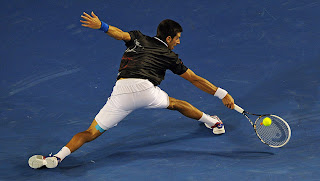

The numbers are just phenomenal, and no wonder Djokovic is tired and looks beaten. That’s ten hours of tennis in his semi-final and final combined, whereas his first five matches took ten hours and fifteen minutes combined. Compelling stuff, made even more so by Djokovic breaking straight back. That’s 4-4, and for a moment the two trade service games once more; 5-5. Who would break first? A battle of will and endurance: a battle of the mind. The crowd have begun to forget their alliances now; they cheer every point, and if it was only possible to crown both players the winner, I’m sure everyone would agree to do so.

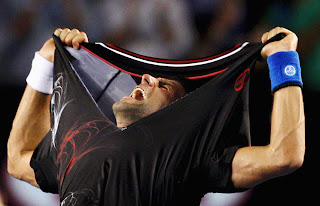
Both players dig deep for one last momentous effort, but for one player the strain is just too much. Djokovic believes; he strikes for the killer blow to see off the Spaniard in front of him, and with some incredible play finds the break. He leads 6-5, and serves for the match and the tournament. For Nadal once again it isn’t to be; Djokovic collapses to the ground and the cheers and applause reverberates all around the stadium. Not just for the Serbian, but for Nadal too; both players producing a spectacle that has to be listed up there with the best of the finals there has ever been.